Forbes & Lomax — The Language of Finishes
Forbes & Lomax: the precision of detail — the poetry of finishes
In a world where detail is often subordinated to function, Forbes & Lomax builds its identity precisely from detail itself. More than a maker of switches and sockets, it positions itself as an ongoing exploration of the relationship between material, surface, and architecture. Its finishes are not merely decorative — they are the essence of the language that defines each piece.
The grammar of material
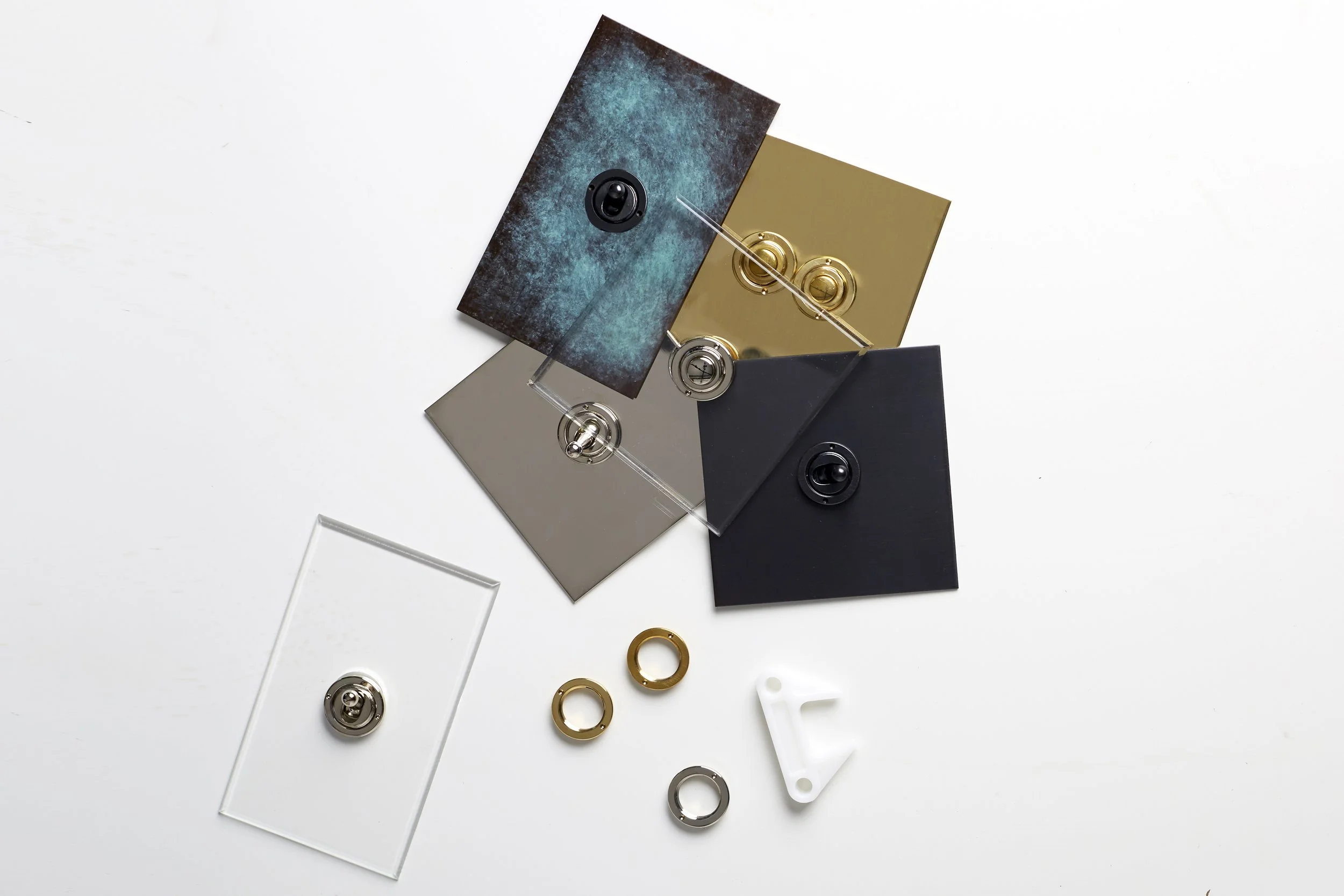
The Forbes & Lomax collection of finishes reveals an almost architectural approach to object design. Each surface is conceived as an extension of the space it inhabits, either by dissolving into it or by asserting a quiet, controlled presence.
At the core of this philosophy lies the idea of integration: the object does not interrupt the environment, but participates in it. This intention is expressed through both understated and more expressive finishes, creating a coherent system where all elements share the same formal discipline.
Invisible: disappearance as luxury
The Invisible finish is perhaps the most emblematic expression of this philosophy. A transparent acrylic plate allows the wall surface to continue uninterrupted, enabling paint, wallpaper, or texture to pass visually through the object.
Here, the finish is not surface — it is absence. The luxury lies precisely in this restraint: the ability to reduce physical presence to a minimum without compromising technical precision or detailing.
Living metals: time as finish
In contrast to invisibility, metallic finishes introduce a tactile and evolving dimension. Brass, nickel, stainless steel, and bronze are not treated as static surfaces, but as living materials.
Particularly in unlacquered brass, time becomes an integral part of the design. Oxidation and everyday use gradually create a unique patina, turning each piece into a silent record of the space it inhabits. The finish ceases to be a final state and becomes an ongoing process.
Restraint and balance
Other finishes, such as brushed metals or stainless steel, introduce a more contemporary and architectural reading. Their controlled neutrality allows seamless integration into modern interiors, where clarity and visual calm are essential.
In these cases, the finish acts as a mediator between technology and space, offering precision without visual noise.
Surface as identity
Forbes & Lomax demonstrates that finish is not a secondary detail, but a structural design decision. Each material choice defines how the object interacts with architecture, light, and touch.
Even in the most discreet systems, there is a clear intention: to reduce excess, eliminate distraction, and elevate spatial experience. The finish becomes a form of silent language.
Between presence and absence
The true balance of the brand lies in its ability to operate between two poles: absolute invisibility and refined material presence. On one side, the dissolution of the object into the space; on the other, the assertion of material as an architectural element.
It is within this duality that Forbes & Lomax constructs its identity — not through exuberance, but through precision; not through accumulation, but through consistency of detail.
An aesthetic of permanence
In a context where interiors are often driven by fast-moving trends, the finishes of Forbes & Lomax articulate a different understanding of time. They are conceived to endure — not only physically, but visually.
Their relevance is not dictated by fashion, but by the intrinsic quality of the material and the way it ages, reacts, and integrates into space over time.
The finishes of Forbes & Lomax therefore represent one of the most subtle expressions of contemporary design: an aesthetic in which what matters is not what is added, but what is removed — or what is allowed to evolve.
Ultimately, true luxury is not found in the surface itself, but in the way it allows space to breathe through it.
Sources & Photos: Forbes & Lomax